


In the world of power transmission, selecting the optimal gear system is critical for efficiency, performance, and cost effectiveness. Two distinct and commonly used types are worm gears and bevel gears. While both excel at changing the direction of rotational motion, their operating principles, advantages, and ideal applications differ significantly. This article provides a comparative analysis to guide your design and selection process.
1. Fundamental Geometry and Operation
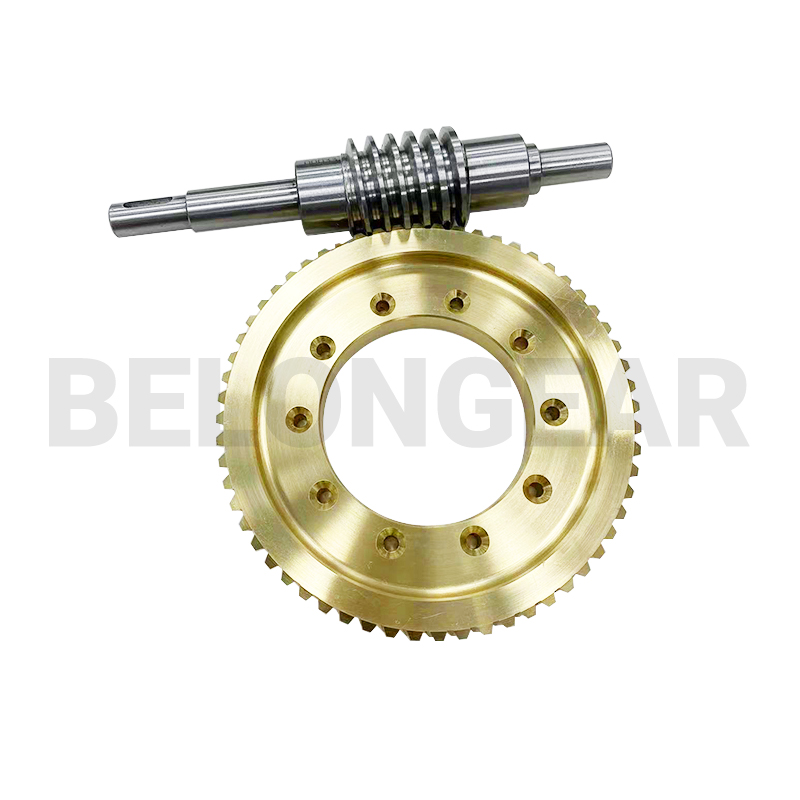
- Worm Gear: Consists of a screw-like worm (the driving component) that meshes with a toothed worm wheel. The axes of the worm and the wheel are non-intersecting and typically perpendicular, with a 90-degree orientation being the most common. Motion transfer occurs through a sliding action.
- Bevel Gear: Comprises two conical-shaped gears with interlocking teeth. The shafts of the two gears intersect, and the angle between them is typically, but not exclusively, 90 degrees. Motion transfer occurs primarily through a rolling action.
2. Key Comparative Advantages
| Feature | Worm Gear | Bevel Gear |
|---|---|---|
| Speed Reduction & Torque | Extremely high single-stage reduction ratios (5:1 to 100:1+). Excellent for achieving high torque multiplication in a compact space. | Offers moderate reduction ratios (typically 1:1 to 6:1 in a single stage). Higher ratios require complex or multi-stage designs. |
| Self Locking | A unique advantage: Due to the high friction and shallow lead angle, the worm can easily drive the wheel, but the wheel cannot drive the worm back. This provides inherent backdriving prevention, ideal for hoists, lifts, and safety mechanisms. | Generally not self-locking. Torque can be transmitted in both directions unless an external brake is added. |
| Efficiency | Lower efficiency (typically 50%-90%) due to predominant sliding contact, which generates more heat and friction. Requires robust lubrication and cooling for high-power applications. | Higher efficiency (typically 95%-99% for precision types) due to the rolling action between teeth. Less energy is lost as heat. |
| Smoothness & Noise | Operates very smoothly and quietly because of the progressive tooth engagement and sliding contact. | Can be noisy at high speeds, especially if not precision-manufactured. Smoothness depends on tooth design (e.g., straight vs. spiral). |
| Space Configuration | Ideal for non-intersecting, perpendicular shafts that need to be offset. Allows for a compact package where input and output shafts are not in the same plane. | Designed for intersecting shafts (usually perpendicular). The gears are mounted on shafts that meet at a point. |
| Cost & Complexity | Worm manufacturing is complex, but the system can be cost-effective for high-ratio, low-to-mid power applications. The worm wheel is often made from a softer material (e.g., bronze). | High-precision bevel gears (especially spiral bevels) are complex to design and manufacture, often leading to a higher cost for high-performance applications. |
3. Typical Applications
- Worm Gears: Conveyor systems, gate operators, tuning mechanisms (e.g., guitar pegs), packaging machinery, elevators/lifts (utilizing self-locking), and anywhere a large speed reduction and high shock load resistance are needed in a single stage.
- Bevel Gears: Automotive differentials (the classic example), hand drills, marine propulsion systems, power plants, printing presses, and any application requiring a change in the direction of a high-speed, high-power shaft with minimal energy loss.
Conclusion: The Right Tool for the Job
The choice between a worm gear and a bevel gear is not about which is better overall, but which is better for your specific requirements.
- Choose a Worm Gear when you need: Very high reduction in one stage, self-locking capability, quiet operation, and non-intersecting shafts. Be prepared to manage lower efficiency and associated heat.
- Choose a Bevel Gear when you need: Efficient power transmission between intersecting shafts, high-speed capability, and reversible motion. Be prepared for potentially higher noise and cost for precision units.
By carefully evaluating factors like required ratio, shaft orientation, efficiency needs, and the necessity for backdriving prevention, engineers can make an informed decision that ensures reliability and optimal performance in their mechanical systems.
Post time: Feb-12-2026