


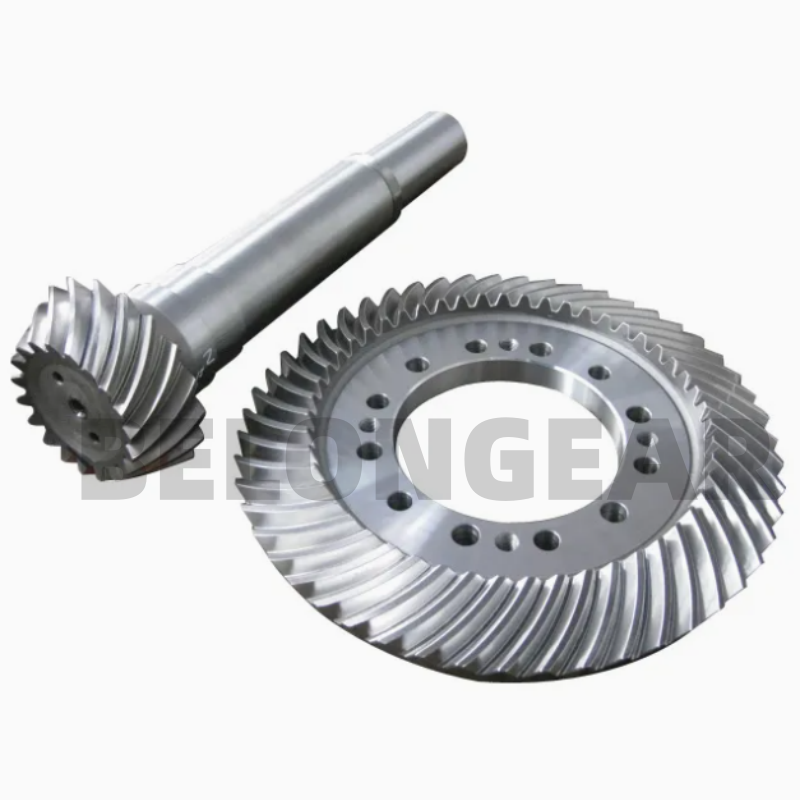
Spiral Bevel Gear vs Spur Gears
Key Differences, Applications, and Selection Guide for Industrial Systems
In industrial power transmission systems, choosing the right gear type has a direct impact on efficiency, reliability, noise level, and service life. Two of the most widely used gear types are spiral bevel gears and spur gears. Although both serve the purpose of transmitting torque and motion, their designs, operating principles, and applications are fundamentally different.
At Belon Gear, we manufacture custom spiral bevel gear and spur gears for global B2B customers across industries such as industrial machinery, automotive, robotics, and heavy equipment. This article explains the key differences between these two gear types and provides guidance on selecting the right solution for your application.
What Is a Spiral Bevel Gear
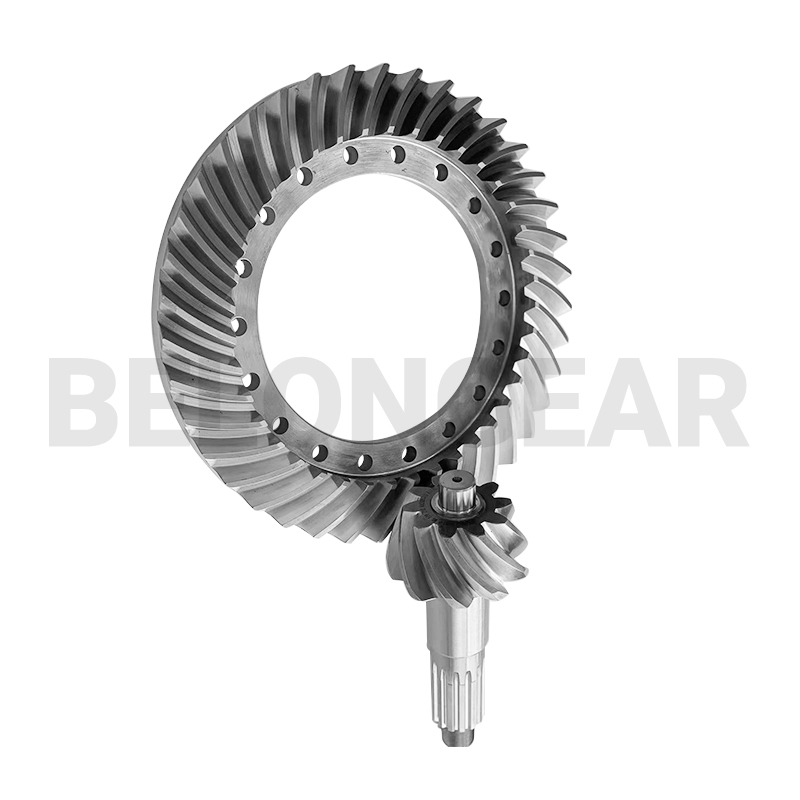
A spiral bevel gear is a type of bevel gear designed to transmit power between intersecting shafts, most commonly at a right angle. Its teeth are curved and set at an angle, allowing gradual engagement between mating gears.
This tooth geometry provides smoother operation, higher load capacity, and reduced vibration compared to straight bevel gears. Spiral bevel gears are commonly used in applications where precision, quiet operation, and high torque transmission are required.
Key Features of Spiral Bevel Gears
Designed for intersecting shaft configurations
Curved teeth for smooth and continuous engagement
High torque and load capacity
Lower noise and vibration levels
Suitable for high-speed and heavy-duty applications
What Is a Spur Gear
A spur gear is the most basic and widely used type of gear. It features straight teeth that are parallel to the gear axis and transmits power between parallel shafts.
Spur gears are known for their high efficiency, simple design, and ease of manufacturing. Due to their straightforward structure, they are commonly used in a wide range of industrial and mechanical systems.
Key Features of Spur Gears
Designed for parallel shaft arrangements
Straight tooth profile
High mechanical efficiency
Simple structure and cost-effective production
Easy installation and maintenance
Spiral Bevel Gear vs Spur Gears: Key Differences
| Feature | Spiral Bevel Gear | Spur Gear |
|---|---|---|
| Shaft orientation | Intersecting shafts | Parallel shafts |
| Tooth geometry | Curved and angled | Straight |
| Load capacity | High | Medium |
| Noise and vibration | Low | Higher at high speeds |
| Operating smoothness | Very smooth | Less smooth |
| Speed capability | High | Moderate |
| Manufacturing complexity | Higher | Lower |
| Cost level | Higher | Lower |
Performance Comparison in Industrial Applications
Torque and Load Capacity
Spiral bevel gears provide a larger contact ratio and gradual tooth engagement, allowing them to transmit higher torque under demanding conditions. Spur gears are suitable for moderate loads but may experience increased stress when used in heavy-duty systems.
Noise and Vibration
Due to sudden tooth engagement, spur gears tend to generate more noise at higher speeds. Spiral bevel gears engage progressively, resulting in quieter operation and reduced vibration, which is critical in precision machinery and automotive systems.
Efficiency and Speed
Spur gears offer excellent efficiency because of minimal sliding between teeth. Spiral bevel gears involve some sliding contact, but modern manufacturing and surface finishing techniques significantly reduce energy loss.
Typical Applications of Spiral Bevel Gears and Spur Gears
Spiral Bevel Gear Applications
-
Automotive differential systems
-
Industrial right-angle gearboxes
-
Robotics reducers and joints
-
Heavy machinery transmission systems
-
Precision and high-speed mechanical equipment
Spur Gear Applications
-
Industrial gear reducers
-
Conveyors and material handling systems
-
Packaging and processing machinery
-
Agricultural and construction equipment
-
General-purpose mechanical drives
At Belon Gear, both spiral bevel gears and spur gears can be custom-designed to meet specific torque, speed, and durability requirements.
How to Choose Between Spiral Bevel Gears and Spur Gears
When selecting the appropriate gear type, engineers should consider the following factors:
-
Shaft orientation required in the system
-
Torque and load demands
-
Operating speed and noise limitations
-
Installation space and gearbox layout
-
Cost and maintenance considerations
If your system requires smooth, quiet operation with high torque transmission between intersecting shafts, spiral bevel gears are the preferred solution. If efficiency, simplicity, and cost-effectiveness for parallel shafts are the priority, spur gears are often the better choice.
Custom Gear Solutions by Belon Gear
Belon Gear is a professional manufacturer of custom gears for B2B customers worldwide. Our manufacturing capabilities include:
-
Custom spiral bevel gear and spur gear design
-
Precision gear cutting and grinding
-
Advanced heat treatment processes such as carburizing and quenching
-
High-quality alloy steel and stainless steel materials
-
Consistent quality control for demanding industrial applications
Our engineering team works closely with customers to ensure each gear meets performance, reliability, and service life requirements.
Post time: Dec-18-2025